
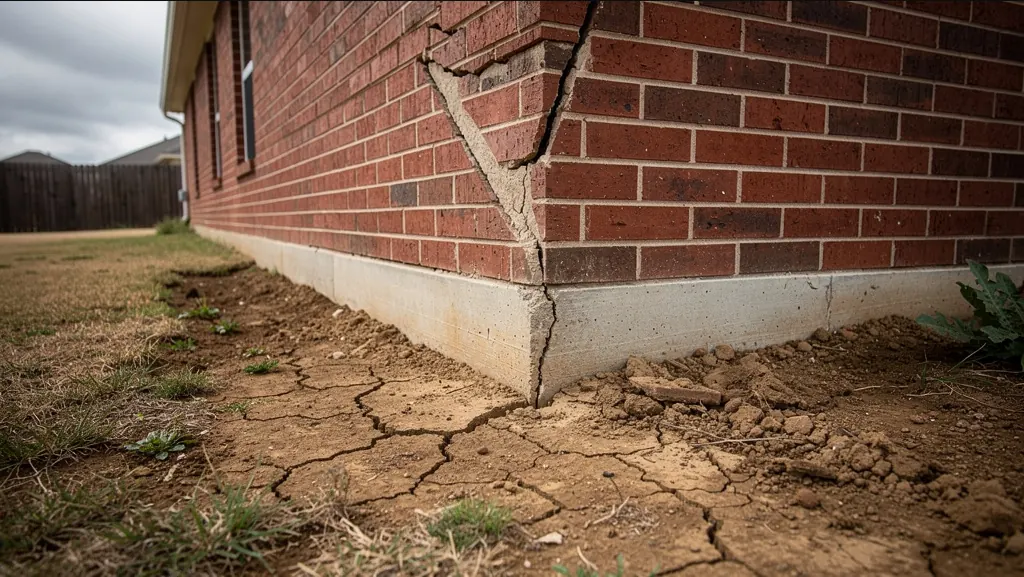
Signs your foundation is moving
Foundations rarely fail all at once. They settle, tilt or heave a little at a time, and the house tells you through the parts that are supposed to stay square.
- Doors and windows that stick, will not latch, or show a wedge-shaped gap at the top of the frame.
- Drywall cracks that start at the corners of doors and windows and run on a diagonal.
- Brick cracks outside, especially stair-step cracks that follow the mortar lines.
- Gaps at baseboards or where the wall meets the ceiling.
- Floors that slope, or tile that cracks in a straight line across a room.
- Cabinets and countertops pulling away from the wall.
One hairline crack is not a verdict. Concrete shrinks as it cures, and Angi's crack guide notes that vertical cracks are the most common kind and are rarely a sign of structural damage. Pattern and change are what matter. Put a pencil mark at each end of a crack and write the date beside it. If it grows, or you see three or four of these signs on the same side of the house, book a foundation inspection.
Why Frisco soil moves your house
Frisco sits in Collin and Denton counties. A satellite soil mapping study of Collin County describes deep, clayey soils of the Houston Black-Austin, Houston Black-Houston and Houston Black-Burleson associations across its uplands and stream terraces. Houston Black is the textbook clay of the Texas Blackland Prairie.
The Texas Almanac says Blackland soils are known as "cracking clays" because of the large, deep cracks that form in dry weather, and that this high shrink-swell property can cause serious damage to foundations. The USDA groups soils like this as Vertisols: soils high in expanding clay that swell when they get wetter and shrink as they dry.
Here is how that plays out on a normal lot. Frisco gets about 39 inches of rain a year, and the average July high is 96 degrees. After a spring storm, the soil under the front beds is soaked. In late summer, the soil on the west side bakes and pulls away from the slab. One corner rises, another drops. That uneven movement is what cracks drywall and racks door frames. Texas A&M AgriLife Extension makes the same point: watering one part of the yard and letting another go dry can crack brick veneer and push doors out of alignment.
Foundation repair services we connect you with
Every request goes to an independent pro who handles foundation work. The services overview explains each one in short form.
Slab foundation repair
Most repairs on a concrete slab involve piers driven or pressed under the low areas to lift and support them. Slab foundation repair covers the signs, the steps and the questions to ask.
Pier and beam foundation repair
Homes with a crawl space sit on piers and beams. Repairs range from re-shimming to new piers and new beams. See pier and beam foundation repair.
Foundation crack repair
Some cracks need a sealer. Others are a symptom of movement that has to be stopped first. Foundation crack repair helps you tell the difference.
Foundation inspection
An inspection measures the floor, checks cracks and doors, and looks at drainage before anyone quotes a fix. Start with a foundation inspection if you are not sure what you are seeing.
Drainage correction
Gutters, downspout extensions, grading and French drains keep soil moisture even around the slab. Drainage correction is often part of a lasting repair.
What foundation repair costs around Frisco
These are ranges reported by Angi's 2026 cost data. They are not quotes. Your real price comes from the pro's on-site look.
| Job | Reported range | Area |
|---|---|---|
| Foundation repair, most homeowners | $2,225 to $8,133 | National |
| Foundation repair, typical range | $3,338 to $7,118 | Dallas |
| Concrete slab repair | $445 to $15,000 | Dallas |
| Pier and beam repair | $775 to $12,500 | Dallas |
| Piering or stabilizing | $1,000 to $6,000 | Dallas |
| Crack repair | $500 to $4,300 | Dallas |
| Drainage work | $900 to $11,900 | Dallas |
| Foundation inspection | $300 to $3,000 | National |
The foundation repair cost guide breaks down what pushes a job to the low or high end.
Repairing before you sell
Texas sellers of previously occupied homes fill out a Seller's Disclosure Notice. The current TREC form asks about defects in the foundation or slab, improper drainage, settling or soil movement, previous structural repair, and repairs made without necessary permits. A buyer's inspector will look at the slab either way. You can repair before listing and hand buyers the paperwork, or get an inspection and a written quote so you can price the issue into the deal. Both work better than surprises at the option period. Frisco's permit fee schedule lists foundation repair as its own permit line, so ask who pulls the permit and keep the record.
How it works
- Use the form. Tell us your ZIP code, what you are seeing, and where in the house it shows up.
- We match you with a pro. We pass your request to an independent foundation repair pro who serves your part of Collin or Denton County.
- On-site look. The pro walks the house, measures floor elevations, checks cracks, doors and drainage, and explains what is moving.
- Written quote. You get the scope in writing: the method, how many piers if any, drainage work, permit and warranty terms.
- You decide. There is no obligation. Compare it with other bids and take your time.
How to choose a foundation repair company
- Ask whether a licensed professional engineer will review the plan or sign off when the work is done.
- Ask what type of pier they use, how deep it goes, and why that fits your soil.
- Ask who pulls the City of Frisco permit and who schedules the inspection.
- Get the warranty in writing and ask whether it transfers to a buyer.
- Ask what they will do about drainage, not just the low corner.
- Get more than one quote. Angi suggests talking to at least three pros.
Be careful with anyone who pushes you to sign the same day or quotes a price without measuring the floor.
Where we serve
Requests come in from Frisco and the towns around it in Collin and Denton counties, including Prosper, Little Elm, The Colony, McKinney, Plano and Allen. The full list is on the service areas page.
Why use a referral service
We are straight about what we are. Pierstone Foundation Repair does not pour concrete or drive piers. There are no crews here. What we do is take the first step off your plate: finding a foundation pro who works your area and is set up to come look. The pro is an independent business. You should still check their insurance, references and any license that applies to the work before you sign anything. Pros may pay us for referrals, and that never changes what you pay them.