
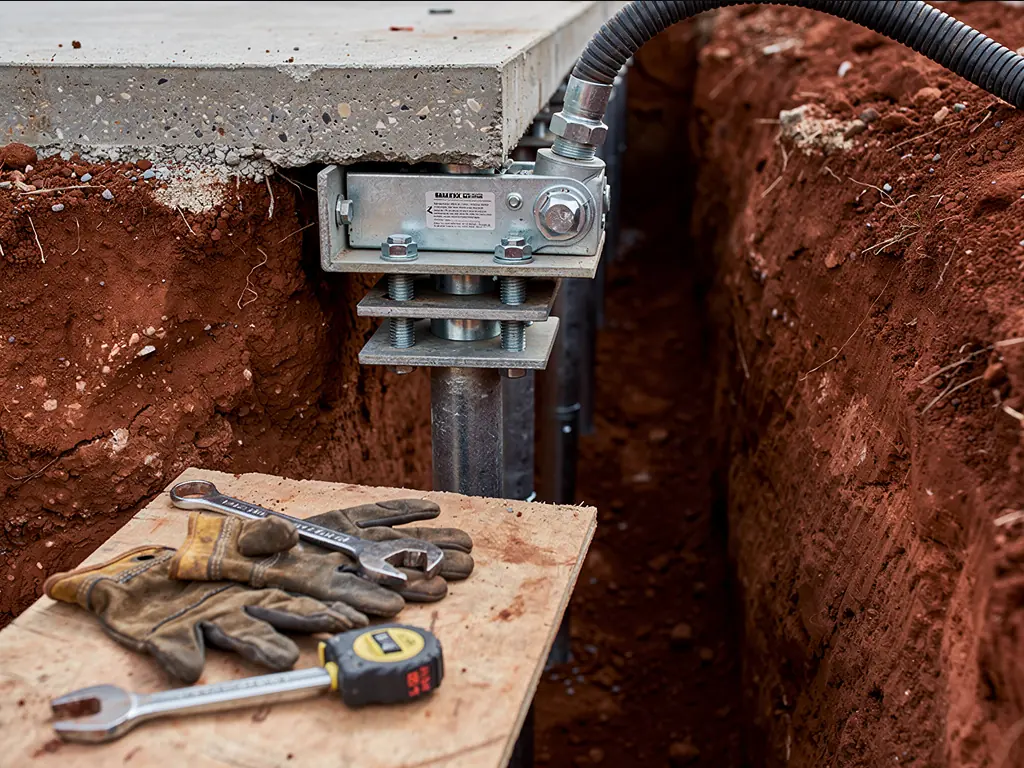
Homes that sit on piers
You likely have a pier and beam foundation if there is a vent or access door low on the outside wall, or a hatch in a closet floor that opens to a crawl space.
The soil still matters. A satellite soil mapping study of Collin County describes deep, clayey soils across its uplands, including the Houston Black-Austin association. Each pier sits on that clay, and when the clay under a few piers shrinks or swells more than the rest, the beams above them follow. Moisture in the crawl space adds its own problems for wood.
What tells you a pier or beam has slipped
- Floors that slope, sag in the middle of a room, or feel springy when you walk.
- New creaking that was not there last year.
- Cabinets or built-ins pulling away from the wall.
- Large drywall cracks around door and window openings.
- Doors that swing open or closed by themselves.
- Damp, musty air or standing water in the crawl space.
Angi's pier and beam guide notes that center piers tend to settle first under heavier loads, and that visible insect or water damage on the wood usually means at least some replacement. Uneven floors, cabinets separating and big drywall cracks around openings point the same way.
How the repair usually goes
- Crawl space inspection. The pro goes under the house to check each pier, the shims, the beams and the joists, and looks for wood rot, insect damage and standing water.
- Floor readings. Elevation readings across the rooms show which sections have dropped and by how much.
- Written plan. The pro lists what will be re-shimmed, which piers will be added or replaced, which beams will be swapped, and whether any moisture or drainage work is part of the job.
- Support work. The crew jacks the low section a little at a time, sets new shims or piers, and replaces damaged wood. Work in the middle of the house takes longer because space is tight.
- Final check. New floor readings, a walk-through to test doors, and the warranty and permit paperwork in your hands.
Pier and beam repair prices
These ranges are from Angi's 2026 pier and beam cost guide. They are a starting point, not a quote. The pro's look under your house sets the real price.
| Repair | Reported range |
|---|---|
| Typical full job, most homeowners | $6,000 to $14,000 |
| Re-shimming | $1,200 to $4,000 |
| Adding a new pier | $800 to $4,000 each |
| Replacing a pier | $2,000 to $6,000 each |
| Underpinning | $1,000 to $3,000 per pier |
| Replacing a beam | $400 to $1,200 each |
| Gutter system to control runoff | $1,000 to $8,000 |
Angi puts the national average for pier and beam repair at about $10,000, or roughly $6 to $8 per square foot. Piers in the middle of the house usually cost more to reach than piers near the edge. For slab and pier and beam side by side, see the foundation repair cost guide.
What to ask before you hire
- Did you check every pier, or only the ones near the problem area?
- Is the problem settlement, rot, moisture, or a mix? What causes it?
- What are the shims made of, and how are they secured?
- Do I need any crawl space moisture work or drainage correction as part of this?
- Will you pull the Frisco permit?
- What does the warranty cover, and does it transfer to a buyer?
If you are not sure whether the floor problem is the foundation at all, a foundation inspection is the place to start. Homes on concrete should read about slab foundation repair. To get a local pro out to look, use the form.